When you stand before a painting you love, the question of value rarely presents itself clearly. You feel the pull of the work before you can articulate why. But at some point, particularly when a significant sum is involved, the question surfaces: what actually makes this piece worth what it costs?
This is a reasonable question, and one that deserves a direct answer. The value of an original artwork is not arbitrary. It is determined by a set of factors that can be understood and evaluated, even by collectors with no formal training in art history. Understanding these factors does not reduce art to a transaction: it gives you the confidence to make decisions that reflect both what you feel and what you know.
This guide explores the determinants of value in contemporary original art, from the most legible signals of quality and recognition to the subtler factors that distinguish a work of lasting significance from one of passing appeal. It does not address speculative market dynamics or resale potential: those questions belong to a different conversation. What follows concerns the qualities that make an original work genuinely worth acquiring and living with.
In this guide:
What Value in Art Actually Means
The Artist's Training and Technical Foundation
Career Trajectory: Understanding Where an Artist Stands
Professional Recognition: Societies, Prizes, and Elections
Exhibition History and Institutional Placement
The Work Itself: Scale, Medium, and Complexity
Rarity and the Value of a Handmade Original
-
 Morag YoungMixed media on boardPort Life IIIFramed Size: 58 x 108 cm
 -
Madeleine GardinerOil on canvasOcean RainUnframed size: 100 x 100 cm
-
Career Trajectory: Understanding Where an Artist Stands
An artist's career stage is one of the most practically significant factors in both the price of their work and its long-term interest to collectors. Artists at different stages offer different propositions, and understanding those differences helps you make decisions that align with what you are looking for.
Emerging artists, broadly defined as those in the first decade of serious professional practice, typically offer work at lower prices than their established peers. The trade-off is that their trajectory is less certain: some will develop into significant figures, others will not. Collecting at this stage requires either a strong personal conviction about the work, or enough spread across several artists to absorb the uncertainty.
Mid-career artists, with ten to twenty years of consistent practice behind them, offer a different balance. Their technical development is usually mature, their artistic identity is defined, and there is enough exhibition history to assess how their work has developed and where it is heading. Prices are higher than for emerging artists, but the uncertainty is correspondingly lower.
Established artists with long careers and significant exhibition records offer the most legible value proposition. Their work is priced to reflect their standing, and the factors that underpin that standing are visible and verifiable: institutional recognition, public collections, critical attention, and a body of work that has proved its coherence and quality over time.
Neal Greig RUA has been painting landscapes in oil for over thirty years, working from direct observation outdoors in a practice rooted in the long tradition of plein-air painting. His election to the Royal Ulster Academy in 2019 reflects peer recognition that follows a career of consistent, serious work. His paintings are held in public collections including those of the Arts Council of Northern Ireland and the Office of Public Works. These are not decorative indicators: they represent decisions by professionally constituted bodies to place his work in permanent public holdings, which is among the strongest signals of sustained quality available. See Neal Greig's available works.
Professional Recognition: Societies, Prizes, and Elections
The professional structures of the fine art world include a number of bodies that exist specifically to recognise quality in practice. Membership of these bodies is not self-nominated: it is conferred by existing members on the basis of assessed work, which makes election a meaningful signal rather than a credential that can be purchased or claimed.
In Scotland, the most significant of these are the Royal Scottish Academy (RSA), the Royal Scottish Society of Painters in Watercolour (RSW), and the Royal Glasgow Institute of the Fine Arts (RGI). At UK level, bodies including the Royal Academy, the Royal Watercolour Society, and the Royal Society of Portrait Painters carry comparable weight. Election to any of these organisations as a full member or academician, as opposed to associate status, represents a formal judgement by a substantial body of professional peers that the artist's work merits sustained recognition.
Prizes awarded through these bodies, and through open competitions such as the RSA Annual Exhibition or the John Moores Painting Prize, provide additional data points. They are assessed by panels that change from year to year, which means a single prize carries less weight than a pattern of recognition across multiple contexts over time.
Jennifer Irvine holds dual fellowship of the RGI and RSW, having been elected to both bodies following a career of more than thirty years of full-time painting. Her awards include the David Cargill Award, the Mark Greer Award, and the Sir William Gillies Award. These are not honorary gestures: each represents a competitive assessment process. The Robert Fleming Collection, a significant institutional holding of Scottish art, includes her work. This combination of elected society memberships, competitive prizes, and institutional collection placement is precisely the pattern of recognition that distinguishes an artist of lasting standing from one of momentary prominence. See Jennifer Irvine's available works.
Exhibition History and Institutional Placement
An artist's exhibition record tells you a great deal about how their work has been received and by whom. A pattern of solo shows at recognised commercial galleries, alongside representation in group exhibitions at institutional venues, indicates an artist whose work has been consistently assessed as gallery-worthy by professionals with reputations to protect. Conversely, an artist whose exhibition record is limited to open submission shows and self-organised events offers a less legible track record.
Institutional placement is a stronger signal still. When a public gallery, museum, or significant corporate collection acquires a work, it does so following a process of professional assessment and, in many cases, committee approval. Acquisitions by the Scottish National Portrait Gallery, the City Art Centre, national museum collections, or university collections represent durable endorsements that sit outside the commercial art market entirely.
Joyce Gunn Cairns MBE is an Edinburgh-based figurative painter whose career spans more than four decades. She holds nine works in the permanent collection of the Scottish National Portrait Gallery, five in the City Art Centre, and works in the collections of Balliol College Oxford and Jesus College Cambridge. She was awarded an MBE for services to art. These are not peripheral achievements: they represent the sustained attention of some of the most rigorous institutional assessors of artistic quality in the country. An artist at this level of institutional engagement offers a collector both the intrinsic quality of the work itself and the reassurance of an independently verified record of recognition. See Joyce Gunn Cairns's available works.
-
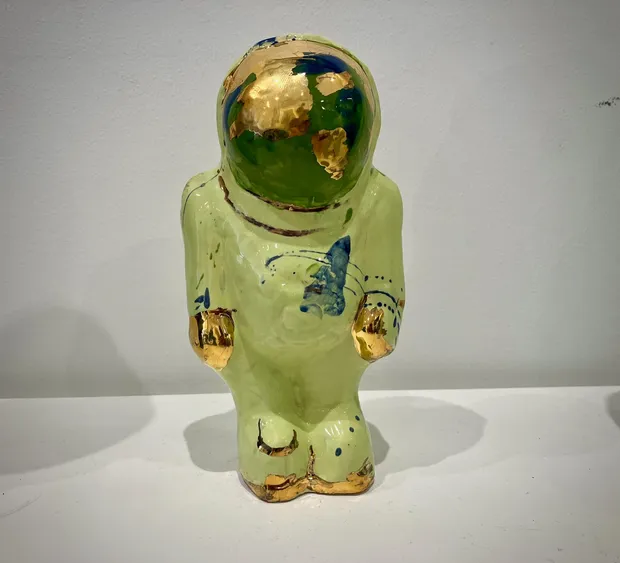
Arran RossCeramic with coloured glazeAstronaut - Honeydew - Special EditionHeight: 18cmAP
-
Rarity and the Value of a Handmade Original
Original works are unique. When an artist completes a painting or a hand-built ceramic, that exact work exists once. This is a fundamental difference from limited edition prints, which exist in a specified number of identical examples, and from open edition reproductions, which exist in unlimited number. The uniqueness of an original is not merely a commercial claim: it reflects the fact that every decision made in the course of making the work, every brushstroke, every choice of colour, every modification to the composition, is unrepeatable.
For collectors, this uniqueness is one of the most significant sources of enduring satisfaction in owning original art. The work on your wall is not one of many: it is the specific object that the artist made, carrying the evidence of the decisions and the process that brought it into being. No reproduction, however technically accomplished, can replicate this quality.
In ceramic art, rarity extends to the firing process itself. Each work that enters a kiln is subject to conditions that the artist can influence but not fully control: temperature, atmosphere, and the chemical behaviour of glazes at high heat all introduce an irreducible element of the singular. Two bowls thrown on the same day, from the same clay, with the same glaze, will emerge from the kiln differently. This is not a limitation of the medium: it is one of its most compelling qualities, and it is why experienced collectors of ceramics value pieces that show evidence of the maker's engagement with material process rather than pieces that aspire to an industrial uniformity.
For guidance on building a collection over time, including how to develop your eye and deepen your understanding across different mediums and styles, see our guide on building an art collection. For personalised guidance on works currently available at Graystone, contact the gallery or visit us in Stockbridge.
Evaluating Contemporary Art with Confidence
The practical implication of everything above is that evaluating contemporary art does not require specialist knowledge so much as a willingness to look carefully, ask questions, and pay attention to a defined set of signals. When you encounter a work that interests you, the following questions will give you a reliable framework for assessment.
First, the work itself: does it reward sustained looking? Does it reveal qualities that were not immediately apparent? Is the surface alive or flat? These are questions about intrinsic quality, and your own responses to them are a more reliable guide than you might expect.
Second, the artist: what is their training background, and where have they exhibited? Are they members of any professional bodies? Do they have work in public or institutional collections? How long have they been exhibiting, and has the quality of their work developed consistently over that time?
Third, the gallery: is it a commercial gallery with a professional curatorial position, or an open-submission venue? Does it represent artists whose work has been independently recognised? Does it provide information about the artists it shows in enough depth to support an informed decision?
A gallery that takes its curatorial responsibilities seriously, that represents artists with demonstrable track records, and that provides genuine information about the works it shows, is itself a signal of value. The relationship between a collector and a gallery they trust is one of the most practically useful assets in building a collection that gives lasting satisfaction.
Frequently Asked Questions
What makes art valuable?
The value of an original artwork reflects a combination of factors: the artist's training and technical mastery, their career stage and trajectory, professional recognition through elected societies and prizes, institutional collection placements, exhibition history, the scale and medium of the work, and the intrinsic quality visible in the work itself. No single factor is decisive; the most legible value propositions involve a consistent pattern of recognition across multiple dimensions over time.
What makes a painting valuable?
For paintings specifically, value is shaped by the artist's demonstrated skill in handling the medium, the complexity of the compositional and tonal decisions embodied in the work, the quality of the materials used, and the artist's professional standing as evidenced by their exhibition record and recognition. Size influences price in proportion to the time and materials involved, but exceptional quality in a smaller work will always outweigh routine execution in a larger one.
How do I assess the value of a contemporary artwork?
Begin by evaluating the work itself: does it reward sustained looking and reveal depth over time? Then research the artist: training, exhibition history, professional memberships, and any public or institutional collection placements. Consider the gallery context: a professionally curated gallery with a serious programme represents a degree of independent curatorial assessment that is itself informative. Finally, ask the gallery directly: a good gallery will be able to give you a clear account of why a work is priced as it is.
Does professional society membership matter when buying art?
Elected membership of bodies such as the RSW, RGI, RSA, or Royal Ulster Academy is a meaningful signal because it reflects assessment by professional peers rather than self-nomination. It does not guarantee that every work an artist makes is exceptional, but it indicates a sustained level of quality over a period of time sufficient to earn the recognition of a professional body. Associate membership carries less weight than full election.
What is the difference between original art and a limited edition print?
An original work, whether a painting, drawing, or hand-built ceramic, is unique. A limited edition print exists in a specified number of identical examples, typically signed and numbered by the artist. Original prints made through printmaking techniques (etching, lithography, screenprint) are considered original works in their own right, not reproductions. Open edition prints are reproductions available in unlimited quantity and carry the lowest value. For a fuller explanation, see our guide to art forms and mediums.
Should I buy art I love or art that might hold its value?
The most sustainable basis for collecting is genuine personal connection to the work. A piece acquired purely on speculative grounds, without authentic engagement, tends to become a source of anxiety rather than pleasure. Fortunately, the factors that make art genuinely satisfying to live with, quality, authenticity, and depth, are closely aligned with the factors that underpin lasting significance. Buying work you find genuinely compelling, from artists with demonstrable careers, through galleries with serious programmes, is both the most enjoyable and the most considered way to build a collection.